


Florid Gorestone
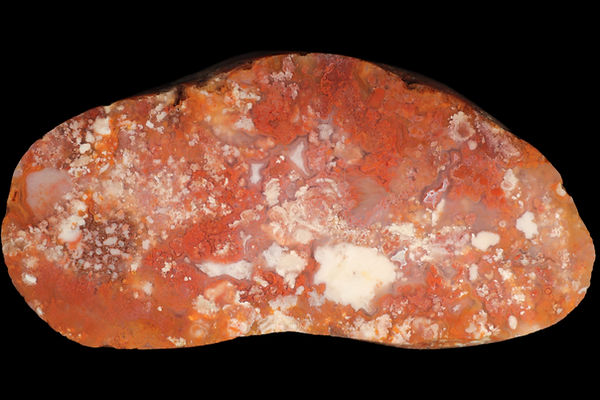
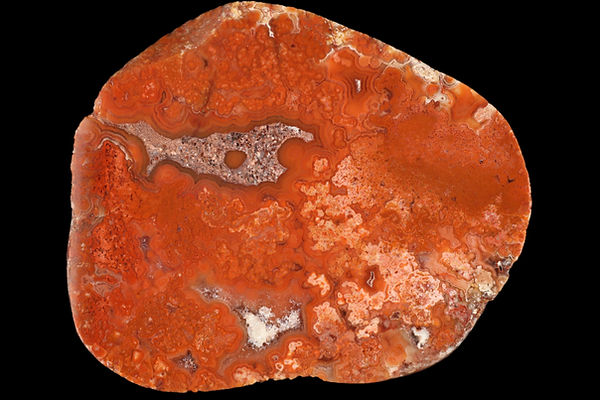
Florid Gorestone is a particular species of jasp-agate found uniquely in Angus that likely has it's secondary source in the Old Red Sandstone Conglomerates, where they meet the coast. So, as with the agates of the Kintyre Peninsula on Scotland's West Coast, these specimens have weathered the erosive cycle twice. Florid Gorestone is highly varied, and may include fortification agate, moss agate, plume agate, whorled agate, orbs, and stalactitic or sagenitic structures. These examples are all featured elsewhere on this site, where details of size and photography credits are carefully noted. However, it may be useful to see many of them gathered here together. The original source is likely long lost, and unseen. Great braided rivers once fed into the sea here, and moved agate, jasp-agates and many other minerals from great mountains to the south and east, as rounded pebbles, which in turn became buried in the red sand that millions of years later became the Old Red Sandstone Conglomerate. So, these pieces likely already lay water-worn in shingle banks 410 million years ago. The huge variation in structures from one area to the next, relates to the huge source area. It is quite possible that caches of similar material are found together, simply because they have eroded from the ORS together at a particular time, from a particular place and have arrived in a limited area. I have personally seen evidence of this. These are particularly ancient and curious agates, that as far as I'm aware, have never been studied in-depth. The jasper and agates contained within the ORS conglomerates become concentrated, simply because of the durability of the material. The conglomerates may only carry scant examples of tumbled pebbles of andesite, quartzite, rhyolite, granite and various metamorphic rocks, however the jasper, jasp-agates and agates often predominate in the areas they are deposited because they weather their changes so gracefully. It should be noted however, that most material is unremarkable, and it takes a great deal of time and effort to locate the more outlandish examples.
This material first came to my attention during 2018, and I resisted it's collection for a number of years, until I found I could no longer ignore it. It spoke to me. In fluting and sonorous tones. It is highly ornate, and wonderfully expansive when viewed under magnification. There is always at very least a spattering of claret tones in every example and this aspect is no doubt due to their immersion in the iron-rich ORS conglomerates for millions of years. My focus is on the examples that contain agate, in whatever guise it may be. Those examples that do not contain agate, are no less interesting, but agate is my focus nonetheless. The more ordinary agates of the region may, in some cases, also have weathered from the ORS conglomerates, however in my experience I have located several examples of agate, jasp-agate and related material, still attached to sections of local andesite, both in greenish and grey tones. This suggests that not all of the material has eroded from the same source, and as I have previously noted, agates and related material from the Angus Coast have many sources: in local andesites both from the north and south, glacial till in the farmland above and offshore and in the aforementioned ORS conglomerates, which are hugely varied in content, highly localised and hidden.
I plan to continue studying this material, it will be a speciality; the results of which you will continue to see here.


.jpeg)
.jpeg)


.jpeg)


.jpeg)
.jpeg)
.jpeg)
.jpeg)
.jpeg)
.jpeg)


.jpeg)
.jpeg)


